
Stablecoins: The "Boring" Crypto and the Future of Trust
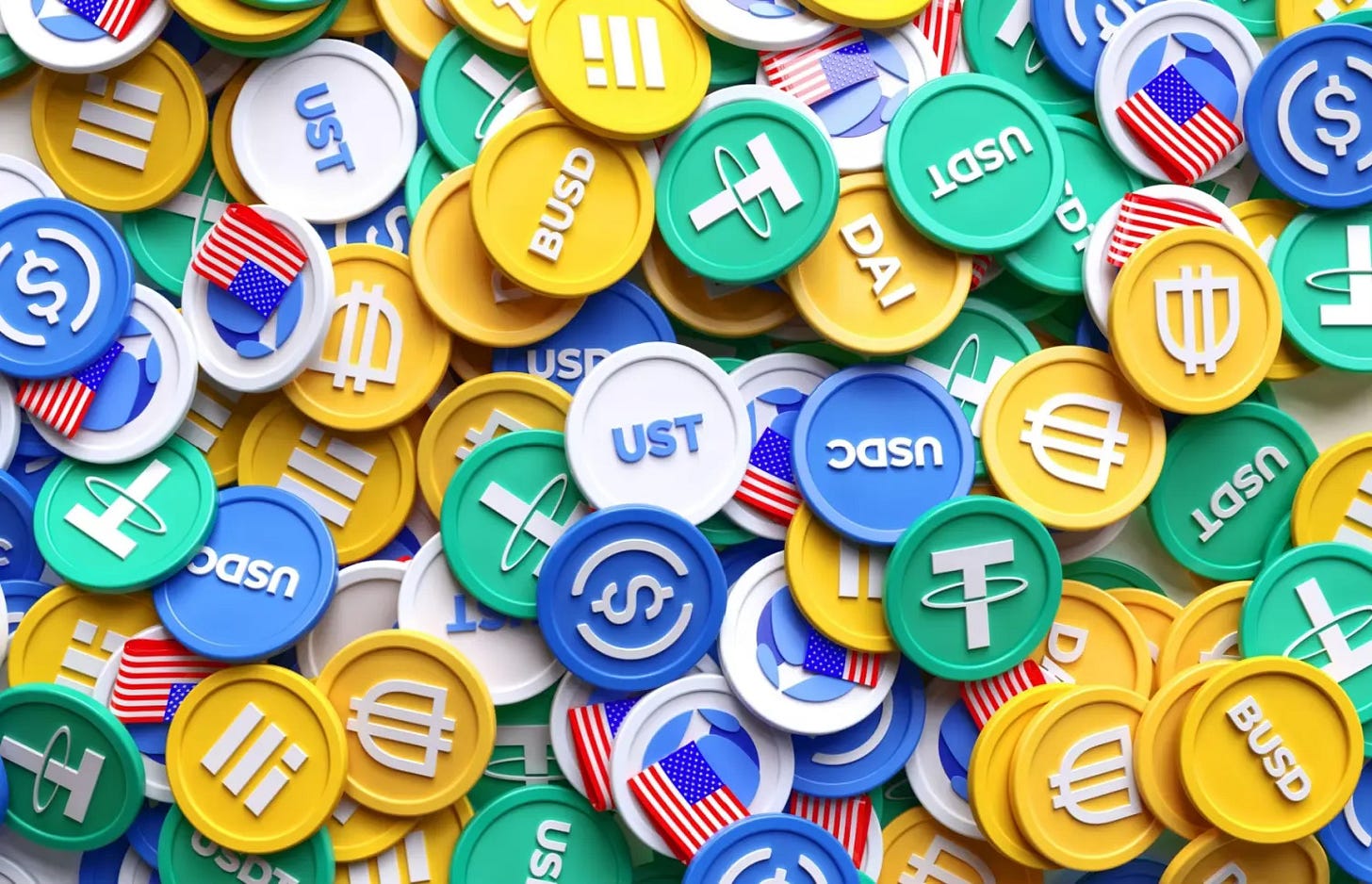
The Trump Administration has made expansion of cryptocurrency a cornerstone of its financial policy. To many, the term “crypto” brings to mind darknet drug markets, sanctions evasion, and money laundering. High profile collapses of crypto exchanges, like FTX and its enigmatic leader Sam Bankman-Fried, have reinforced the notion that crypto is dominated by scammers and otherwise shady characters.
There can be no doubt that the world of crypto is populated by opportunists, scammers and organized crime networks, especially since crypto and the blockchain network that underpins it thrive on the principle of anonymity. But those who espouse the expansion of cryptocurrency into the mainstream financial system see the opportunity to democratize payments and provide faster, easier, and less expensive payment rails.
Today’s payment system is operated by corporations. Each company (a bank or other financial institution like a payment service provider) owns its own payment network and these networks communicate with one another when one entity pays another entity. Each entity charges a fee for that service. These fees add up to a lot of costs to individuals or businesses wishing to make payments to one another.
These fees encompass costs that each payment company incurs, including the costs of building and maintaining compliance functions like Know Your Customer (KYC) and Anti Money Laundering (AML). They also encompass profits.
Some observers of the modern-day financial system have argued that concentrated corporate ownership of financial payment platforms allows for a few financial institutions to extract exorbitant fees through rent-seeking behavior. Chris Dixon, author of the book Read Write Own, argues that these “fee taking middlemen” have created an uneven payments market. For example, the fee structure of today’s financial system heavily favors the largest players, who can negotiate for more favorable fee structures, to the detriment of small business, who have no choice but to pay the highest fees. Banks and payment service providers all charge significant fees for every payment transaction. And these fees are hefty. In 2024, a $200 remittance cost 6.2% in fees, on average.
Another issue with traditional payments systems is time. When a business wants to send money to another business in a foreign country, the payment can take 3-7 days to clear, passing as many as five intermediaries in the process.
This is where stablecoins come in. Stablecoins are a type of cryptocurrency designed to hold a steady value, usually pegged to the U.S. dollar. Unlike Bitcoin or Ethereum, which fluctuate wildly in price, stablecoins aim to stay “stable.” To do that, the issuer of the stablecoin needs a way to make sure that every coin in circulation can actually be redeemed for $1 worth of value. In practice, this means stablecoin issuers maintain reserves equal to the number of stablecoins they issue. Thus, for every stablecoin issued, the issuer (theoretically) holds a dollar, or something close to a dollar, like a short-term U.S. Treasury bond, in a reserve account. For example, if Circle, along with Tether, one of the two primary stablecoin issuers, issues 10 million “USDC,” it should have $10 million in cash or Treasuries in custody somewhere. This way, if you turn in your coin, you can get real money back.
Stablecoin transactions, like other cryptocurrency payments, are maintained using a blockchain ledger. A blockchain is a kind of digital record book that’s copied and shared across thousands of computers. Everyone in the network has the same copy. In this way, you can think of it as Google Docs for money and data, everyone can see the same version, it updates in real time, and it’s very hard to fake or erase. Because it’s a shared network, no one company owns the ledger, like with a traditional bank. This decentralized environment is both an opportunity and a risk.
The promise of stablecoins as a payment rail lies in the efficiency of the transactions. Since stablecoin issuers make use of a decentralized ledger, they can save the costs (such as audit and compliance) of maintaining a corporate ledger. Costs are also saved by making payments directly to the recipient, instead of touching multiple intermediaries, each of which extracts a fee under the traditional payments system. And there is a time savings component as well—these payments can be made instantaneously, instead of taking up to a week to clear.
For more than a decade, the debate over stablecoins has been running in parallel across industry, regulatory bodies, and academic circles. Enthusiasts tout them as the “boring middle ground” of crypto, a way to bring stability to the wild west nature of the crypto ecosystem. Skeptics argue that, far from boring, stablecoins are both a systemic risk and a fraud magnet. The truth, as always, lies in the balance between their potential as financial infrastructure and their vulnerabilities to fraud, money laundering, and operational failure.
The Stablecoin Debate: From Fringe to Policy Priority
Early stablecoins like Tether (USDT) emerged as settlement tools in crypto trading, providing a dollar-equivalent to move between exchanges. Mostly stablecoins were used as “on- and off-ramps” to crypto exchanges—a bridge from crypto to fiat, including the dollar. Over time, newer entrants like Circle’s USDC and PayPal’s USD token have sought legitimacy through partnerships with mainstream institutions. What began as a niche tool has become a serious policy issue.
Proponents argue that stablecoins offer lower-cost cross-border payments, instant settlement, and programmable money that can plug directly into digital economies. Regulators, however, have repeatedly warned about run risks, reserve misstatements, operational failures, and systemic shocks if stablecoin issuers are not adequately supervised. And fraud and AML risk are generally considered very high given the decentralized and anonymous nature of crypto transactions.
With the July 2025 passage of the GENIUS Act, the debate has evolved from “whether” to adopt, to “how” to regulate. But lingering questions about fraud and compliance remain unresolved.
Fraud and AML Risks in the DeFi Ecosystem
Stablecoins sit at the center of the broader decentralized finance (DeFi) landscape, which has been both a laboratory of innovation and a playground for criminals. DeFi replaces traditional intermediaries with so-called_smart contracts._ A smart contract is basically computer code that runs automatically on a blockchain when certain conditions are met. Think of it like a digital vending machine: You put in a dollar (the input). The machine checks the rules (Do you have enough money? Is the item in stock?). If the conditions are satisfied, the machine dispenses a soda (the output). Nobody needs to stand there to approve the transaction—it happens automatically. But the people standing there to approve the transaction in the payments ecosystem serve as trusted gatekeepers and removing them introduces new vulnerabilities. These include:
Cross-border money laundering. Stablecoins move at internet speed, allowing illicit actors to bypass the banking system through mixers, weakly regulated exchanges, or cross-chain swaps.
Synthetic and stolen identities. Fraudsters use AI-generated documents or hacked personal data to onboard wallets, often at smaller exchanges with weaker compliance controls.
Mule networks. Criminals recruit unwitting individuals to move stablecoin funds, making detection harder.
Smart contract exploits. Bugs or malicious logic in DeFi contracts enable fraudsters to siphon billions in stablecoins from lending pools and exchanges.
Regulators such as the Financial Stability Oversight Council (FSOC) and the Financial Action Task Force (FATF) continue to warn that stablecoins, even with reserve and disclosure requirements, could become rails for money laundering and sanctions evasion if fraud risks are not addressed at scale.
The GENIUS Act: A Strong Floor, Not a Ceiling
The Guiding and Establishing National Innovation for U.S. Stablecoins (GENIUS) Act was signed into law on July 18, 2025. At its core, the law provides a new stablecoin framework that is designed to make these digital tokens look and act more like safe, regulated financial products. Because GENIUS requires that stablecoins be reserve-backed, redeemable at $1, and subject to federal oversight, it gives them features similar to a digital fiat instrument. In other words many hope that stablecoins will become a “digital dollar.”
The GENIUS Act requires stablecoin issuers to be licensed and overseen by federal regulators, hold a dollar in cash or short-term Treasuries for every token they issue, and open their books to regular, independent audits with transparent reporting. Consumers are guaranteed the right to redeem their coins at face value, one-for-one with the U.S. dollar. And to guard against abuse, issuers are required to implement strong AML sanctions screening, and fraud-prevention controls, ensuring these digital assets don’t become a back door for illicit finance.
The law addresses years of uncertainty around legal treatment of stablecoins, but close observers have noted that GENIUS leaves open major questions:
· Run risk: Can non-bank issuers (who will not have access to Treasury’s ledger) manage liquidity crises without central bank backstops?
· Cross-border enforcement: How will regulators handle foreign-issued stablecoins used in U.S. markets?
· On-chain fraud controls: AML checks at on-ramps may not stop laundering through pseudonymous wallets, mixers, or DeFi platforms. How will this be addressed?
· Consumer recourse: GENIUS focuses on issuer prudential standards, not wallet-level fraud disputes or scam protections. How will consumers be protected?
In short, GENIUS provides a solid regulatory baseline, but trust will depend on how agencies implement auditing, reporting frequency, on-chain monitoring, and supervisory playbooks in practice.
Finding Bad Actors using Blockchain Analytics
In response to significant criminal activity in the crypto ecosystem, an industry specializing in the use of software tools and data science techniques to trace and analyze transactions recorded on public blockchains has emerged and grown in the last decade.
While the blockchain provides anonymity to its users, it also offers security advantages: Because every transaction on a blockchain is permanent and transparent, investigators can follow the flow of funds across wallets, identify clusters of addresses likely controlled by the same actor, and flag links to known high-risk services like mixers, darknet markets, or sanctioned entities.
Bad actors eventually need to exchange their crypto for fiat, the so-called “off ramp,” which means eventually they will encounter a KYC check. Being able to trace their movements gives law enforcement the ability to follow them to the “off-ramp.”
In the fraud and AML context, blockchain analytics provides early-warning signals for suspicious activity such as rapid “smurfing” of funds through multiple wallets, cross-chain swaps designed to obscure origin, or the sudden movement of assets into high-risk jurisdictions. Law enforcement agencies, regulators, and compliance teams at exchanges increasingly rely on blockchain analytics vendors (e.g., Chainalysis, TRM Labs, Elliptic) to provide risk scoring, wallet attribution, and investigative dashboards.
While blockchain’s pseudonymity presents challenges, the permanent and auditable nature of the ledger makes it a uniquely powerful tool for uncovering fraud and illicit finance when combined with strong KYC and sanctions-screening practices.
Digital Identity: The Future of Identity Proofing
One recurring theme in both industry proposals and regulatory warnings is the challenge of identity. Stablecoins are most vulnerable where KYC and AML controls drop off. These include in peer-to-peer transfers, self-custody wallets, and DeFi contracts. That’s because it’s very hard to verify the identity of a stablecoin holder once they are transacting within the blockchain, after they have already passed a KYC check in an on-ramp. Emerging technologies are attempting to address this gap, including:
· Mobile Driver’s Licenses (mDLs): mDLs provide digital proof-of-identity and selective disclosure of attributes (like “21+”) without exposing all personal details; they are already accepted by TSA in multiple states;
· Verifiable Credentials (VCs) and Decentralized Identifiers (DIDs): Based on W3C standards, these allow users to carry cryptographically signed proof of KYC or other claims across platforms;
· Zero-Knowledge Proofs (ZKPs): Allow users to prove compliance (e.g., “not on a sanctions list”) without revealing sensitive data;
· Government-backed wallets (e.g., EU Digital Identity Wallet): Pilots are underway to integrate IDs, diplomas, and company credentials, potentially setting a global precedent; and
· Biometric solutions: Iris scans and fingerprints aim to stop mule networks but face significant regulatory headwinds due to privacy risks.
While all these solutions are an attempt to make identity “portable,” each tool carries its own risks, from deepfake attacks on mDLs, to fake credential issuers in VC systems, to audit blind spots in ZKP protocols.
The Road Ahead
Stablecoins are no longer an experiment; they are edging toward integration with mainstream payment systems like FedNow and real-time payments (RTP), which operates popular P2P payment rails like Zelle. That convergence raises the stakes that fraud in stablecoin rails could quickly bleed into the broader financial system.
The path forward requires three things:
1. Audit transparency that goes beyond monthly attestations to near-real-time disclosures.
2. On-chain fraud controls that embed AML, sanctions, and velocity checks into code, and not just compliance manuals.
3. Portable identity systems that strike the balance between privacy and accountability, ensuring that synthetic IDs and mule networks don’t erode trust.
The debate over stablecoins is really a debate about trust. Can a system designed to be borderless, instant, and decentralized also meet the fraud, AML, and consumer-protection standards regulators demand? The GENIUS Act shows that policymakers are ready to set boundaries. But the ultimate credibility of stablecoins will hinge not only on reserves and audits, but also on how effectively the industry weaves identity, compliance, and fraud protection into the fabric of the technology itself.
References
Financial Stability Oversight Council, Report on Digital Asset Financial Stability Risks and Regulation (Washington, D.C.: U.S. Department of the Treasury, 2022)
Chris Dixon, Read Write Own: Building the Next Era of the Internet (New York: Random House, 2024)
Commodity Futures Trading Commission, “CFTC Orders Tether Holdings Limited to Pay $41 Million for Untrue or Misleading Statements,” October 15, 2021
Financial Action Task Force (FATF), “Virtual Assets and Virtual Asset Service Providers,” FATF-GAFI, updated 2025
Bank for International Settlements, Supervising Cryptoassets for Anti-Money Laundering (Basel: BIS, 2021)
International Monetary Fund, Virtual Assets and Anti-Money Laundering and Combating the Financing of Terrorism (Fintech Note, October 2021)
U.S. House Financial Services Committee, “Text of the GENIUS Act,” July 2025
European Union, Markets in Crypto-Assets (MiCA) Regulation, Official Journal of the European Union, 2023
European Commission, EU Digital Identity Wallet Pilot Projects, 2024
Article first posted on GovIntegrity.