
The White House’s New Fraud Ledger Doesn’t Add Up
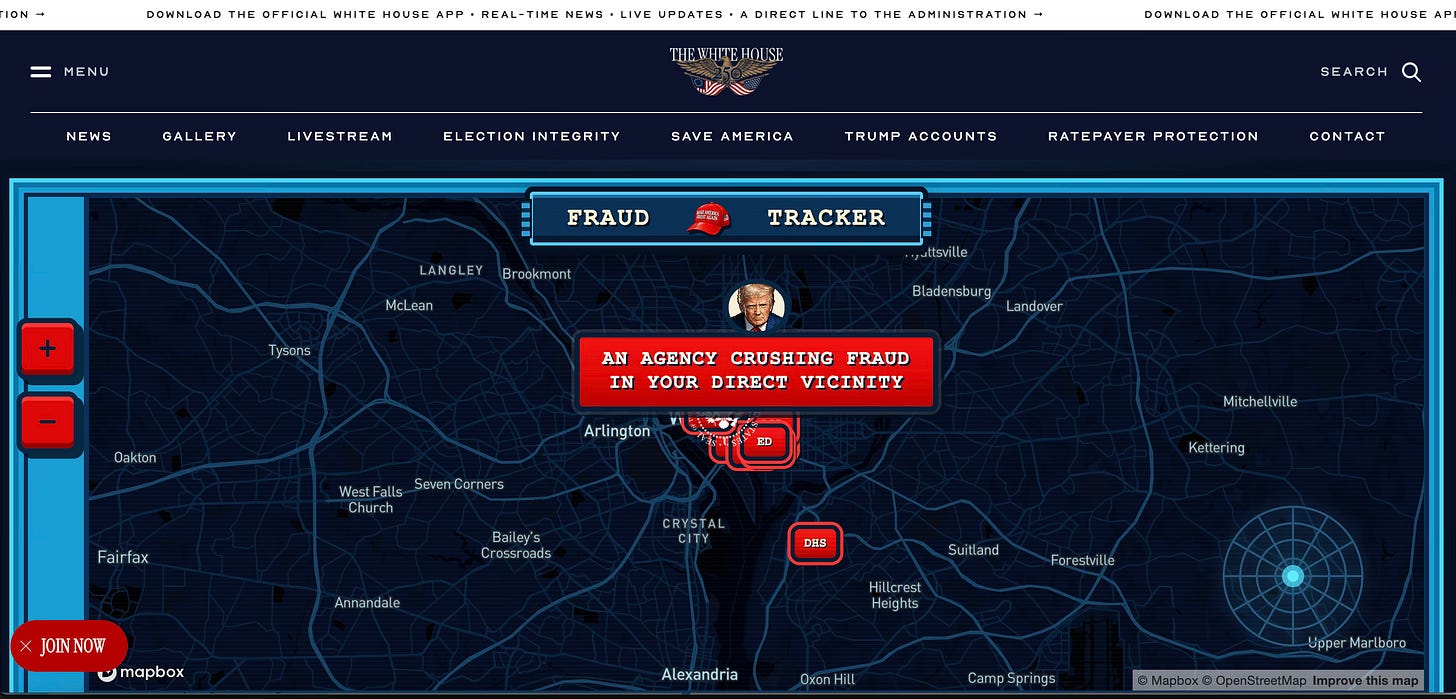
Last month, the White House launched a public ledger of “the fraud, waste, and corruption identified by the Trump Administration’s Task Force to Eliminate Fraud since January 2025.” I’ve been among the voices calling for a public dashboard that catalogs likely fraud losses and funds recovered, adding transparency to the government’s fight against fraud. So naturally, the new Fraud Ledger caught my attention. But then I started trying to reproduce the numbers.
I feel compelled to start with the aesthetics. The new website is designed to look like an old-fashioned criminal case file. The page is black, with a red “Task Force Docket FY 2026” stamp at the top. The interactive fraud map takes the conceit even further, with an almost cartoonish crime-tracker quality. It has the feel of an amateur designer letting ChatGPT take the reins.
At the top of the ledger are three very large numbers. As of this writing, the government reports $245.7 billion in “Fraud Uncovered,” $62.9 billion in “Fraud Stopped” annually, and $59.1 billion in “Fraud Enforced.”
The site does offer definitions. “Fraud uncovered,” it says, represents estimated fraud identified through data analysis. “Fraud stopped” is the amount estimated to be saved annually through administrative actions, such as suspensions and rule changes. “Fraud enforced” covers dollars recovered through indictments, settlements and civil monetary penalties.
But for a public fraud ledger to be meaningful, we should be able to answer some fairly basic questions. Where did a number come from? What period does it cover? Is it an estimate or an established loss? Was the fraud newly identified during the period being reported, or was it identified previously and acted upon during that period? Does the figure overlap with an earlier government estimate? And when the government says money has been “enforced,” does that mean it was charged in an indictment, ordered as restitution, referred for collection—or actually returned to taxpayers?
To answer those questions, I chose one agency on the ledger to explore— the Small Business Administration.
What, exactly, is the $122.9 billion?
According to the Fraud Ledger, SBA has uncovered $122.9 billion in fraud since January 2025. That’s a big number, but I have been unable to reproduce it from publicly available information. The timing here is important because SBA’s pandemic fraud problem was hardly unknown in January 2025. In June 2023, SBA’s Office of Inspector General published a major analysis estimating that more than $200 billion in PPP and COVID-EIDL funds had potentially been disbursed to fraudulent actors. The OIG reached that estimate using investigative casework, previous OIG work and advanced data analytics and it was still citing that same estimate in an update issued in March 2025.
Did SBA identify another $122.9 billion through new analytic work after January 2025? Perhaps it did, but the Fraud Ledger doesn’t give us enough information to know. I have not been able to find a public SBA methodology explaining the $122.9 billion, the population of loans behind it, the fraud indicators used to generate it, or a reconciliation with the earlier $200-plus-billion OIG estimate. SBA’s more recent announcements continue to cite an estimated $200 billion in pandemic-era fraud even as the agency announces new state-by-state investigations and expands its analytic capabilities.
So, we can’t tell whether $122.9 billion represents fraud that had never previously been identified, a new analysis of the same pandemic-loan universe, a subset of loans previously carrying fraud indicators, or some combination of these. The number may be perfectly defensible, but it isn’t currently reproducible.
What about the $22.6 billion?
The SBA enforcement number presents an even more tangible problem. The Fraud Ledger reports $22.6 billion in SBA “Fraud Enforced” since January 2025. The site’s definition says fraud enforced covers dollars “recovered” through indictments, settlements and civil monetary penalties. That is misleading, as an indictment is not a recovery, nor is a settlement.
Another thing worth flagging is that one transaction appears to account for nearly the entire SBA number. On April 24, 2026, SBA announced that it had referred 562,000 suspected fraudulent or delinquent pandemic loans totaling approximately $22.2 billion to the Treasury Department for collection. That was a significant action—the federal government was attempting to collect billions of dollars in delinquent pandemic loans—but a referral for collection isn’t a recovery.
SBA’s announcement describes it as its largest referral package ever. The Fraud Ledger likewise says SBA “referred 562,000 borrowers with $22.2 billion in fraudulent PPP funds to Treasury for collections.” If $22.2 billion of the $22.6 billion enforcement total is attributable to that action, as the figures strongly suggest, then nearly all of the headline SBA enforcement number represents debt sent for collection rather than money already recovered.
And there is an important timing distinction here as well. SBA’s announcement says these loans had previously been flagged as suspected fraud. The current administration took a new and consequential action against them by referring them for collection, which is accomplishment that can be measured and reported. But “previously identified suspected fraud referred for collection” means something different from either “new fraud uncovered since January 2025” or “money recovered since January 2025.”
Definitional problems appear all over the new site. Individual entries in the chronological ledger carrying dollar amounts are labeled “FLAGGED / RECOVERED.” But flagging $100 million in suspected fraud and recovering $100 million are two very different events. The criminal enforcement statistics present a similar challenge. The site reports that DOJ charged 109 defendants associated with $5.4 billion in “intended loss” which is a perfectly legitimate criminal enforcement metric. But intended loss is not money recovered, and it shouldn’t be presented in a way that allows those concepts to bleed together.
Fraud identified, fraud estimated, payments prevented, funds suspended, defendants charged, restitution ordered, debt referred for collection, money recovered—all of these categories are worth measuring, but they are not interchangeable. Government needs good fraud data to determine where its vulnerabilities are, which interventions work, how much to invest in prevention and enforcement, and whether taxpayers are actually getting their money back. A $22 billion collection referral is an important metric, as is $22 billion actually collected. But they aren’t the same thing.
The Fraud Ledger Needs an Audit Trail
I don’t want the government to abandon the Fraud Ledger. I think we need a public accounting of the numbers behind efforts to prevent, detect and recover fraud. As such, I would like to see this become a permanent government-wide program-integrity resource rather than a communications product of any particular administration. But that requires provenance.
For every significant figure, the government should tell us the source of the estimate, the methodology used to calculate it, the period in which the underlying fraud occurred, when it was first identified, whether it overlaps with previously published estimates, and its current disposition. And that last category must be explicit—estimated loss, suspected fraud, payment prevented, funds suspended, charged loss, restitution ordered, debt referred for collection, or funds actually recovered.
There is also a basic temporal problem that needs solving, and to solve it, the politics must be de-coupled from the metrics. Fraud investigations don’t conform neatly to presidential administrations. A suspicious loan may be flagged in 2023, referred for collection in 2026 and partially recovered in 2028. An investigation started under one administration may produce an indictment under the next and a conviction under another. A credible ledger should show that progression rather than forcing each event into a single political reporting period. This calls for de-politicizing the fraud fight and recognizing that a win is a win, no matter which party is responsible for it.
A credible, auditable ledger would make the numbers more useful and would allow policymakers and the public to see where fraud is being detected, where prevention is working, where enforcement is producing results. The White House deserves credit for recognizing that the public should be able to see what the federal government is doing about fraud. A government-wide fraud ledger is an idea worth pursuing. But putting numbers on a website without the necessary context and provenance doesn’t create transparency, it just invites skepticism.
Article first posted on GovIntegrity.