
Trust isn’t Just Vibes
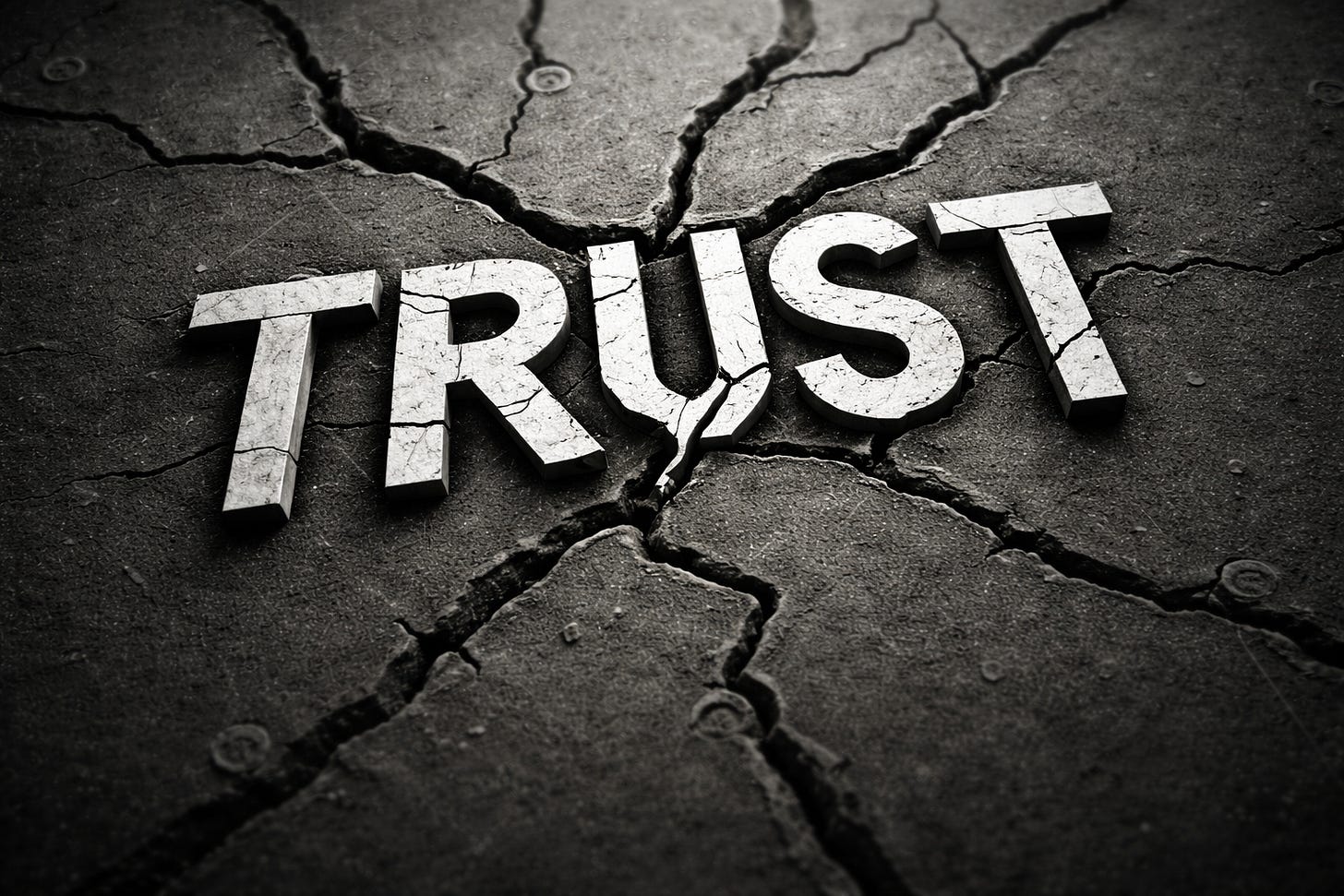
We talk about public trust in government as if it were a mood, something that rises and falls with speeches, scandals, or the political weather. If that were true, restoring trust would mostly be a messaging problem. But public trust isn’t “vibes,” as Gen Z would say. It’s a judgment people make by watching what happens when government systems are stressed: whether rules hold, money goes where it’s supposed to, and anyone notices when it doesn’t.
Trust is an assessment, made daily by people who interact with government. And people evaluate government the same way they evaluate any large system that exercises power over their lives, that is by observing whether it functions effectively. Whether it enforces its own rules, whether it protects resources that belong to everyone, and whether it appears capable of learning from failure. When those signals degrade, trust doesn’t erode because people are cynical but because they’re rational.
If trust is a system-level judgment made collectively, then restoring it requires sustained, structural change. But we treat a systems problem as if it were merely a branding challenge. And that creates openings that sophisticated criminal actors are exploiting at scale.
What is Public Trust in Government?
Public trust is often measured through polling questions that ask whether people “trust the government to do what is right.” That formulation is too abstract to be useful. Trust, in practice, is built from more concrete expectations that most people never articulate but constantly test.
At its core, public trust rests on a belief that government can carry out the functions it assigns itself. That includes the ability to deliver benefits to eligible recipients without intolerable delay, enforce eligibility rules with reasonable consistency, protect public funds from theft or obvious abuse, and respond when problems become visible. Trust requires evidence that failure is the exception rather than the operating condition.
There is also an implicit expectation that rules matter. When government creates eligibility criteria, procurement standards, or enforcement mechanisms, the public assumes these are more than performative gestures. A system that routinely fails to apply its own rules signals that compliance is optional and that outcomes are driven by exploitation rather than merit or need.
Finally, trust depends on accountability. People do not need to read inspector general reports to sense whether misconduct carries consequences. They infer it from patterns. They watch to see whether the same programs are repeatedly defrauded, whether enforcement is episodic, and whether losses are treated as unfortunate but inevitable (see, for example, the pandemic). When accountability becomes abstract or delayed beyond relevance, trust drains away even if oversight technically exists.
These elements are not ideological, they apply regardless of one’s views on the size or scope of government. A progressive who favors expansive public programs can still withdraw trust just as easily as a skeptical conservative who favors a smaller government if those programs appear structurally incapable of protecting themselves.
Effectiveness is a Precondition for Legitimacy
There is a tendency in policy debates to treat effectiveness as a technocratic concern that sits beneath higher-order democratic values. But effectiveness is not a bonus feature of governance.
When government cannot execute, it undermines the moral claim that collective solutions are preferable to private ones.
Every stolen tax dollar, every visibly abused relief program, every acknowledged but unaddressed vulnerability becomes evidence in a broader argument that institutions are incapable of effective stewardship.
This dynamic is especially pronounced in benefit and relief programs, where government interacts directly with individuals and moves money at scale. These programs are where trust is either reinforced or depleted because outcomes are personal and tangible. Citizens experience a delayed benefit payment as indifference, a fraud scandal as betrayal. The fact that systems were “designed for speed” or constrained by legacy technology offers little comfort to those who have firsthand experience with dysfunction.
Effectiveness also shapes political durability. Programs that are perceived as leaky or easily exploited lose defenders over time, including among those who support their underlying goals. Once a program becomes synonymous with waste or abuse, it becomes politically radioactive, regardless of its social value. In that sense, program integrity is not an administrative afterthought. It is the mechanism through which public commitments are preserved.
Public corruption erodes trust in part because it reveals asymmetry. People see that rules are enforced unevenly and that access, sophistication, or proximity to power can insulate bad actors from consequences.
This effect is magnified when corruption appears systemic rather than isolated. A single corrupt official can be dismissed as an outlier. But repeated failures across programs, agencies, or jurisdictions suggest that the system lacks the capacity or will to police itself.
What makes this corrosive is the absence of visible correction. Investigations take years. Recoveries are partial at best. Structural reforms are discussed but rarely implemented at scale. The message received by the public is not that corruption is being addressed, but that it is being absorbed.
Over time, this normalizes failure. When losses are framed as unavoidable, trust does not merely decline; it flips. People begin to assume that abuse is the default state and that compliance is for the naïve. That assumption changes behavior in ways that further weaken systems, from reduced voluntary compliance to political disengagement.
Transnational Criminal Organizations Exploit the Loss of Trust
While domestic debates frame trust as a cultural or partisan issue, transnational criminal organizations are treating it as an operational variable. These groups are not ideologically motivated. They are adaptive enterprises that study institutional behavior, identify points of friction or inertia, and scale exploitation accordingly.
Recent fraud schemes share a common pattern. They exploit gaps between systems, outdated assumptions about risk, or procedural constraints that prevent intervention even when warning signs are obvious.
The Minnesota child nutrition fraud scandal is a clear illustration of how public trust is eroded not by clever criminals defeating strong safeguards, but by actors exploiting the space between systems that were never designed to work together. Tens of millions of dollars intended to feed vulnerable children were diverted through a web of sham nonprofits, fabricated meal counts, and falsified invoices that claimed to serve numbers of children that were, on their face, implausible.
The scheme thrived in the gaps. Between federal reimbursement rules and state-level oversight. Between nonprofit eligibility determinations and ongoing operational verification. Between paper-based attestations and the physical reality of whether meals were ever prepared or served. Between warnings raised by agency staff and the authority to pause payments once those warnings accumulated. No single failure explains the scale of the loss. The architecture itself made exploitation predictable.
Red flags emerged early. Meal counts grew exponentially without corresponding increases in staff, facilities, or community presence. Multiple organizations listed the same addresses, vendors, and leadership networks. Internal concerns were documented, but procedural constraints, litigation risk, and the absence of clear pre-payment denial authority meant that funds continued to flow even as confidence in the legitimacy of the claims receded.
From the public’s perspective, the technical details are beside the point. What is visible is that a program grounded in trust and urgency paid out vast sums with minimal resistance, while oversight lagged behind reality. The impression left is that the system lacked the capacity to stop it when it mattered.
That perception does real damage. It reinforces the belief that government programs are structurally easy to exploit, that accountability is slow and incomplete, and that warnings are often acknowledged only after losses are absorbed. For sophisticated criminal networks both domestic and transnational, this is a market signal.
In the United States, declining public trust exacerbates the fraud threat. For one thing, it reduces political tolerance for enforcement investments. When people doubt government competence, proposals to modernize systems or expand oversight are often met with skepticism rather than support. That hesitation preserves the weaknesses criminals exploit.
Low trust also fragments responsibility. Agencies become risk-averse, focusing on procedural compliance rather than outcomes. Information sharing slows. Decisions that could prevent losses are deferred out of concern for due process challenges or political scrutiny. Fraud thrives in environments where no single actor feels empowered to act decisively.
And finally, distrust fuels disinformation. Criminal organizations increasingly rely on narrative as well as technical exploitation. By amplifying stories of government incompetence or corruption, they weaken public support for enforcement actions and normalize the idea that systems are fair game.
Criminal enterprises are also exploiting the mismatch between modern fraud techniques and legacy governance structures. They operate across borders, jurisdictions, and platforms, while enforcement remains bounded by statutory silos and outdated authorities. Every unresolved trust deficit makes it harder to close that gap, because reform requires public confidence that change will actually improve outcomes.
The Feedback Loop We Are Ignoring
What makes the current moment especially dangerous is the presence of a reinforcing loop that policymakers rarely acknowledge. Declining trust leads to underinvestment in capacity. Underinvestment leads to visible failures. Those failures further reduce trust. External actors exploit the resulting vulnerabilities, accelerating losses and deepening cynicism.
Breaking this cycle requires abandoning the idea that trust can be rebuilt through reassurance alone. People are not withholding trust because they lack information. They are withholding it because they see the dysfunction, often through firsthand experience.
It also requires recognizing that fraud and corruption are more than financial risks, they are governance risks. When public systems are perceived as easily exploited, the legitimacy of collective action itself comes into question.
What Comes Next
Restoring trust starts with treating program integrity as core infrastructure rather than a compliance function. Systems that move large amounts of public money should be designed with prevention in mind, not retrofitted after losses occur.
It also requires modernizing authorities so that agencies can act on high-confidence risk signals in real time, rather than documenting failures after funds are gone. Safeguards and due process matter, but paralysis in the face of brazen fraud and clear abuse undermines legitimacy.
Transparency must shift from disclosure to demonstrated action. Publishing reports is not enough if the public never sees change. Showing how vulnerabilities are closed, how losses are prevented, and how accountability is enforced does more to rebuild trust than any number of dashboards. We need to reward the agencies and leaders who get it right and talk more about programs that are exceeding expectations.
Finally, policymakers need to acknowledge the geopolitical dimension of trust erosion. Transnational criminal organizations are not incidental beneficiaries of institutional weakness, but active participants in exploiting it.
Treating fraud prevention and institutional resilience as matters of national interest, rather than administrative hygiene, would be a meaningful start.
Trust will not return because government asks for it. It will return when government earns it through systems that work. Until then, the erosion of trust will remain a rational response to dysfunction and an open invitation to those prepared to exploit it.
Article first posted on GovIntegrity.